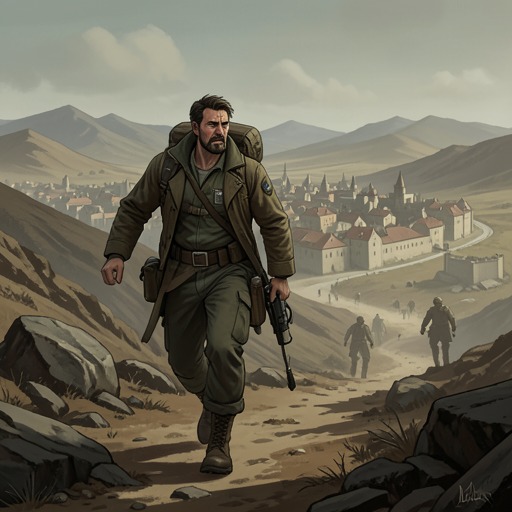
Leandro’s First Attempt to Enter Haven
The TommyknockersJohn Leandro’s first attempt to enter Haven ends in retreat, but it turns the town’s boundary into a visible warning: the barrier is registered in his body before he can understand it. His experience is not unique. A shopkeeper in Troy confirms that other outsiders have returned with nosebleeds, revealing a recurring defense around Haven; later, a break in that defense lets Leandro enter.
Assignment and approach
On the morning of August 15, Leandro crossed into Troy with a mixture of professional anticipation and apprehension. He was pursuing a story inside Haven, a scoop he believed could bring him recognition and provoke the envy of fellow reporter David Bright. Although he had prepared himself for the possibility that he would become ill and have to retreat, he pressed on because the story depended on getting into town.
The approach initially offered little to signal what lay ahead. Troy Village seemed normal, though somewhat slower than usual. The first unmistakable disturbance came through the Dodge’s radio, not from the road: the strong Bangor station WZON began to waver as other broadcasts intruded on it. When Leandro searched the dial, music and voices crowded together, including a Japanese-language broadcast followed by a Beach Boys song sung in Japanese. As the interference thickened across the higher frequencies, he shut the radio off, shaken by a phenomenon he could not explain. Haven lay ahead, close enough to promise an answer, if he could reach it.
The failed crossing
Leandro drove on, but within a mile he began to feel ill. He first attributed the nausea to fear; when it worsened, he considered what he had eaten and recalled a modest breakfast of tea and dry toast. The bodily distress did not stop him. He continued toward Haven, intent on the story, even as the experience increasingly suggested that crossing into the town came at a physical cost.
At the height of the episode, Leandro grasped a mathematical relation and, without realizing its significance, reinvented the general quadratic equation in two variables. The rush of discovery was immediately followed by a severe nosebleed. That marked the end of this first effort to enter Haven. He reversed down the road, unsteady, and drove almost a mile before turning around. His shirt was soaked with blood, but he felt somewhat better; he returned to Troy Village rather than risk continuing.
The pattern beyond Leandro
At the general store, Leandro asked whether other people came back from Haven with bloody noses. The storekeeper answered that it was a familiar occurrence, not an isolated misfortune. On the day Ruth McCausland was buried, he had sold fifteen shirts to out-of-towners who had returned from Haven with blood on their clothing. Some had also been bleeding from their ears. The specific number and occasion give the phenomenon a history: visitors had been reaching the same limit before Leandro, even if the town’s residents treated it as ordinary.
The storekeeper’s account also sharpens the contrast between local knowledge and outside perception. He recognized the pattern well enough to profit from its practical consequence—visitors needed replacement shirts—yet spoke as though being an outsider explained the matter. Leandro, by asking whether the experience happened to others, converted an apparently private physical crisis into evidence of a recurring boundary effect. The town’s defenses were not simply rumors or radio interference; they had measurable consequences for people trying to approach.
A boundary that can change
Leandro’s initial retreat does not settle the question of whether he can enter Haven. Later, as events inside the town intensify, Dick Allison and Newt consider closing the roads with force fields. The batteries are again approaching a critical condition, and the fields could have been established along most routes. But they fear that an outsider who struck an invisible barrier would turn back carrying the story to people beyond Haven. In the confusion, they decide not to block every approach.
When Leandro reaches the town-line marker again, the radio is babbling with a multitude of voices. He switches it off and drives past the marker into Haven without difficulty. The reversal shows that his earlier failure did not arise from an ordinary road obstruction: access depended on a defensive system that could be applied unevenly and changed with the town’s circumstances. The first attempt therefore serves both as a bodily warning and as evidence of a vulnerable perimeter. Haven can repel outsiders, but its protection is neither absolute nor consistently maintained.